 首页
首页 400-620-6333
 4篇引用文献



计算溶液所需的质量、体积或浓度。
This is a demo store. No orders will be fulfilled.

| 货号 (SKU) | 包装规格 | 是否现货 | 价格 | 数量 |
|---|---|---|---|---|
| A266226-20T |
20T |
现货  |
| |
| A266226-50T |
50T |
现货 |
| |
| A266226-100T |
100T |
现货 |
|
| 英文名称 | Annexin V-FITC/PI Apoptosis Detection Kit | ||||||||||||||||||||||||||||||||||||||||
|---|---|---|---|---|---|---|---|---|---|---|---|---|---|---|---|---|---|---|---|---|---|---|---|---|---|---|---|---|---|---|---|---|---|---|---|---|---|---|---|---|---|
| 储存温度 | 避光,-20°C储存,干燥 | ||||||||||||||||||||||||||||||||||||||||
| 运输条件 | 超低温冰袋运输 | ||||||||||||||||||||||||||||||||||||||||
| 备注 | 本产品即将售完下架,替代产品为 A1372286,避免反复冻融,一年有效;如果需要在短时间内多次重复使用,可以在4℃避光保存,半年有效 | ||||||||||||||||||||||||||||||||||||||||
| 产品介绍 |
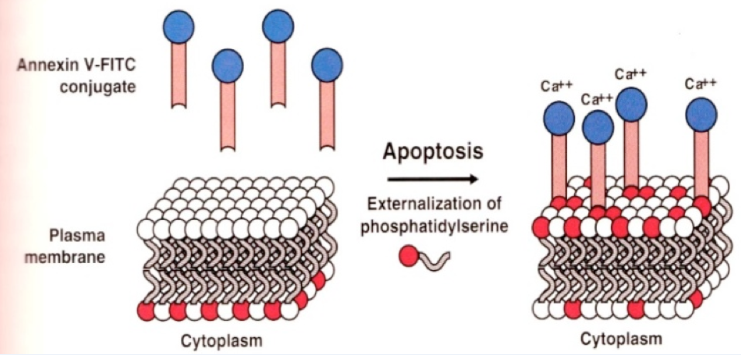
产品介绍 磷脂酰丝氨酸(PS)是一种带负电荷的磷脂,正常细胞中,PS只分布在细胞膜脂质双层的内侧,而在细胞凋亡早期,细胞膜PS由脂膜内侧翻向细胞膜外侧,使PS暴露在细胞膜外表面。Annexin V是一种分子量为35~36kD的Ca2+依赖性磷脂结合蛋白,与磷脂酰丝氨酸有高度亲和力,故可通过细胞外侧暴露的磷脂酰丝氨酸与凋亡早期细胞的胞膜结合。因此Annexin V被公认为检测细胞早期凋亡的灵敏指标之一。 图1. 细胞凋亡过程中磷脂酰丝氨酸(PS)外翻示意图 试剂盒组份
产品参数 所需实验器材 微量移液器;PBS;不含EDTA的胰酶消化液;低速离心机;流式细胞仪 注意事项 1. 此试剂盒仅供研究使用。 2. 微量试剂需离心数秒将试剂收集至管底后再开盖取用。 3. Propidium Iodide(PI)有毒,操作时要带手套,使用时避免与皮肤,眼睛和黏膜接触。 4. Annexin V-FITC中含有剧毒成分叠氮化钠(NaN3), 操作时要带手套,使用时避免与皮肤,眼睛和黏膜接触。
5. 本试剂盒用于检测活细胞,流式细胞仪检测时,细胞数量不应低于1x10^6。
6. 染色后宜尽快检测,时间过长可能会导致凋亡或坏死细胞的数量增加。 7. Annixin V检测凋亡细胞的方法适用于悬浮生长的细胞,如:淋巴细胞等细胞的检测。对于贴壁生长的细胞,由于在胰酶等消化处理过程中会造成细胞膜的损伤,会造成较高的假阳性,而用细胞刮子会造成细胞粘连成团,而影响检测,可将胰酶消化后的细胞保存在含2%BSA的PBS中,防止进一步的损伤。尽管目前,包括国外也有一些单位采用该方法检测贴壁生长的细胞。 8. 消化贴壁细胞残留的胰酶会消化并降解Annexin V-FITC,最终导致染色失败。 9. 细胞固定后可能导致荧光的淬灭,请不要固定样品。 操作说明: 1. 细胞样品的准备: a) 悬浮细胞: 1)收集细胞⾄离⼼管中 1000-2000rpm 离⼼ 5min,⼩⼼去除上清。 2)⽤ 1ml 4℃预冷 PBS 轻轻重悬细胞并计数,1000-2000rpm 离⼼ 5min,⼩⼼吸除上清。 3)再加⼊ 1ml 4℃预冷的 PBS 重悬细胞,1000-2000rpm 离⼼ 5min,⼩⼼吸除上清。 b) 贴壁细胞: 1)吸出细胞培养液⾄离⼼管中,PBS 洗涤贴壁细胞⼀次,加⼊适量不含 EDTA 的胰酶细胞消化液消化细胞。 2)室温孵育⾄轻轻吹打可以使贴壁细胞吹打下来时,吸除胰酶细胞消化液。需避免胰酶的过度消化。 3)加⼊以上步骤中收集的细胞培养液,稍混匀,转移到离⼼管内,1000-2000rpm 离⼼ 5min,⼩⼼吸除上清。 注:加⼊的细胞培养液⼀⽅⾯可以收集已经悬浮的发⽣凋亡或坏死的细胞,另⼀⽅⾯细胞培养液中的⾎清可以有效抑制或中 和残留的胰酶;残留的胰酶会消化并降解后续加⼊的 Annexin V-FITC 导致染⾊失败。 4)⽤ 1ml 4℃预冷 PBS 轻轻重悬细胞并计数,1000-2000rpm 离⼼ 5min,⼩⼼吸除上清。 5)再加⼊ 1ml 4℃预冷的 PBS 重悬细胞,1000-2000rpm 离⼼ 5min,⼩⼼吸除上清。 2. ⽤去离⼦⽔按 1:4 稀释 Binding Buffer(4ml Binding Buffer+12ml 去离⼦⽔); 3. 用 250µl 结合缓冲液重新悬浮细胞,调节其浓度为 1×10⁶ /ml; 4. 取 100µl 的细胞悬液于 5 ml 流式管中,加入 5µl Annexin V-FITC,轻轻混匀; 5. 室温(20-25℃)避光孵育 10min; 6. 上机前 5min 加⼊ 10µl 碘化丙啶溶液,轻轻混匀; 7. 上机前在反应管中补加 400µl PBS 重悬细胞, 避光保存,随即进⾏流式细胞仪(FACS)检测, Annexin V-FITC 为绿⾊荧光,PI 为红⾊荧光。 Product description Phosphatidylserine (PS) is a negatively charged phospholipid. In normal cells, PS is only distributed inside the lipid bilayer of the cell membrane. In the early stage of apoptosis, the cell membrane PS turns from the inside of the lipid membrane to the outside of the cell membrane. PS is exposed on the outer surface of the cell membrane. Annexin V is a Ca2+-dependent phospholipid binding protein with a molecular weight of 35~36kD. It has a high affinity for phosphatidylserine, so it can bind to the cell membrane of early apoptosis cells through phosphatidylserine exposed outside the cell. Therefore, Annexin V is recognized as one of the sensitive indicators for detecting early cell apoptosis. The Annexin V is labeled with green fluorescence (FITC), and the labeled Annexin V is used as a probe to detect the occurrence of cell apoptosis using a fluorescence microscope or flow cytometer. Propidium Iodide (PI) is a nucleic acid dye. It cannot penetrate the complete cell membrane of normal cells or early apoptotic cells. However, PI can penetrate the cell membrane in the middle and late stages of apoptosis and necrotic cells. Stain the nucleus red. Therefore, the method of double staining with Annexin V and PI can distinguish cells in different stages of apoptosis.
Figure 1. Schematic diagram of phosphatidylserine (PS) eversion during cell apoptosis Kit components
Product parameters Ex(nm): 490 Em(nm): 520 Required laboratory equipment Micropipette; PBS; trypsin digestion solution without EDTA; low-speed centrifuge; flow cytometer Precautions 1. This kit is for research use only. 2. Micro-reagents need to be centrifuged for a few seconds to collect the reagents to the bottom of the tube before opening the cap for use. 3. Propidium Iodide (PI) is toxic. Wear gloves when handling it and avoid contact with skin, eyes and mucous membranes. 4. Annexin V-FITC contains sodium azide (NaN3), a highly toxic ingredient. Wear gloves when handling and avoid contact with skin, eyes and mucous membranes. 5. This kit is used to detect live cells, and the number of cells should not be less than 1x10^6 during flow cytometry. 6. It is advisable to test as soon as possible after staining, too long time may lead to an increase in the number of apoptosis or necrotic cells. 7. The Annixin V method for detecting apoptotic cells is suitable for the detection of cells growing in suspension, such as lymphocytes. For adherent cells, the cell membrane will be damaged during the digestion process such as trypsin, which will cause high false positives. The use of cell scrapers will cause the cells to adhere and form clusters, which will affect the detection. The digested cells are stored in PBS containing 2% BSA to prevent further damage. Although at present, some units including foreign countries also use this method to detect adherent growth of cells. I do not recommend using this method to detect. Because of its poor repeatability and the need to be very careful when operating. 8. Trypsin remaining after digesting adherent cells will digest and degrade Annexin V-FITC, which will eventually lead to staining failure. 9. After the cells are fixed, fluorescence may be quenched. Please do not fix the sample. Instructions: 1. Preparation of cell samples: a) Suspension cells: 1) Collect the cells into a centrifuge tube and centrifuge at 1000-2000rpm for 5min, carefully remove the supernatant. 2) Gently resuspend the cells with 1ml of 4°C pre-cooled PBS and count, centrifuge at 1000-2000rpm for 5min, and remove the supernatant by suction. 3) Add 1ml of 4°C pre-cooled PBS to resuspend the cells, centrifuge at 1000-2000rpm for 5min, and remove the supernatant by suction. b) Adherent cells: 1) Aspirate the cell culture medium into a centrifuge tube, wash the adherent cells once with PBS, and add an appropriate amount of EDTA-free trypsin cell digestion solution to digest the cells. 2) Incubate at room temperature until the adherent cells can be removed by gentle pipetting, and then aspirate the trypsinized cell digestion solution. Over-digestion with trypsin should be avoided. 3) Add the cell culture medium collected in the above steps, mix it slightly, transfer it to a centrifuge tube, centrifuge at 1000-2000rpm for 5min, and remove the supernatant by suction. Note: On the one hand, the added cell culture medium can collect suspended apoptotic or necrotic cells, and on the other hand, the serum in the cell culture medium can effectively inhibit or neutralize the residual trypsin; Enzymes will digest and degrade subsequently added Annexin V-FITC causing staining to fail. 4) Gently resuspend the cells with 1ml of 4°C pre-cooled PBS and count, centrifuge at 1000-2000rpm for 5min, and remove the supernatant by suction. 5) Add 1ml of 4°C pre-cooled PBS to resuspend the cells, centrifuge at 1000-2000rpm for 5min, and remove the supernatant by suction. 2. Dilute the Binding Buffer 1:4 with deionized water (4ml Binding Buffer+12ml deionized water); 3. Resuspend the cells with 250µl of binding buffer to adjust the concentration to 1×10⁶/ml; 4. Take 100µl of cell suspension into a 5 ml flow tube, add 5µl Annexin V-FITC, and mix gently; 5. Incubate at room temperature (20-25°C) for 10 minutes in the dark; 6. Add 10µl propidium iodide solution 5 minutes before putting on the machine, and mix gently; 7. Add 400µl PBS to the reaction tube to resuspend the cells before putting on the machine, store in the dark, and then perform flow cytometry (FACS) detection, Annexin V-FITC is green fluorescence, PI isRed fluorescence. |
| 分子类型 | 试剂盒 |
|---|
通过匹配包装上的批号来查找并下载产品的 COA,每批产品都进行了严格的验证,您可放心使用!
| 批号(Lot Number) | 证书类型 | 货号 |
|---|---|---|
 J2513611 J2513611 |
分析证书 | A266226 |
| J2513800 |
分析证书 | A266226 |
| E2526003 |
分析证书 | A266226 |
| E2526004 |
分析证书 | A266226 |
| E2526005 |
分析证书 | A266226 |
| E2417398 |
分析证书 | A266226 |
| C2518720 |
分析证书 | A266226 |
| C2518723 |
分析证书 | A266226 |
| C2518726 |
分析证书 | A266226 |
| L2409714 |
分析证书 | A266226 |
| L2409715 |
分析证书 | A266226 |
| L2305255 |
分析证书 | A266226 |
| L2305254 |
分析证书 | A266226 |
| I2404393 |
分析证书 | A266226 |
| I2404395 |
分析证书 | A266226 |
| I2404397 |
分析证书 | A266226 |
| E23291292 |
分析证书 | A266226 |
| E2417397 |
分析证书 | A266226 |
| E2417396 |
分析证书 | A266226 |
| L2305253 |
分析证书 | A266226 |
| H2314046 |
分析证书 | A266226 |
| H2317148 |
分析证书 | A266226 |
| H2317149 |
分析证书 | A266226 |
| I2223563 |
分析证书 | A266226 |
| E23291293 |
分析证书 | A266226 |
| I2223564 |
分析证书 | A266226 |
| I2223565 |
分析证书 | A266226 |
| 1. Chen Jie, Feng Chengyu, Lan Yufei, Chen Xiangtian, Peng Zhengqi, Huang Zihan, Wang Ruiqing, Zhang Wenxin, Ye Yingying, Mao Zhilei, Pan Dongyue, Yang Lihua. (2025) Bidirectional regulation of reactive oxygen species for radiosensitization in nasopharyngeal carcinoma. JOURNAL OF NANOBIOTECHNOLOGY, 23 (1): (1-19). [PMID:39923065] [10.1186/s12951-025-03177-5] |
| 2. Jiale Chen, Pan Ran, Yizhao Xu, Mouna Khouchani, Xin Li, Ling Jian, Takoui Abdelmajid, Nadia Aittahssaint, Qian Yang, Jingyi Li, Long Zhao. (2025) Biomimetic multifunctional nanoparticles for improved radiotherapy and immunotherapy in cancer treatment. Materials Today Bio, 32 (101698). [PMID:40225127] [10.1016/j.mtbio.2025.101698] |
| 3. Shiqi Wu, Yuxuan Ge, Yuan Peng, Yunsheng Chen, Zheng Zhang, Yixin Zhang. (2025) H2S/Curcumin Coreleasing Biomineralized Zinc Sulfide Nanostructures for Diabetic Wound Healing. ACS Applied Nano Materials, [10.1021/acsanm.4c07309] |
| 4. Yadi Fan, Ruolin Zhang, Jingyu Shi, Feng Tian, Yu Zhang, Li Zhang, Guangfu Liao, Mo Yang. (2024) Mild near-infrared laser-triggered photo-immunotherapy potentiates immune checkpoint blockade via an all-in-one theranostic nanoplatform. JOURNAL OF COLLOID AND INTERFACE SCIENCE, [PMID:39276517] [10.1016/j.jcis.2024.09.020] |