This is a demo store. No orders will be fulfilled.
 首页
首页 400-620-6333

Guidelines for Using Isotype Control Antibodies

Licia Miller Product Manager
1. Definition and function of isotype control antibodies
Isotype control antibody is a negative control reagent that has the same immunoglobulin class, subclass, and light chain type as the research antibody (experimental antibody) but does not bind to the target antigen.
Its core functions are:
1. Evaluate nonspecific binding: Nonspecific binding of the antibody Fc segment to cell surface Fc receptors (such as B cells, macrophages, etc.) may lead to false positive signals. Isotype controls can help distinguish this background interference.
2. Define the negative threshold: In quantitative experiments such as flow cytometry, the "negative zone" is set by isotype controls to provide a baseline reference for specific staining.
3. Verify experimental conditions: optimize blocking, washing and other steps to ensure the specificity of antibody binding.
2. How to choose an isotype control antibody
The selection of isotype control antibodies should follow the "five matching principles":
1. Species matching: consistent with the species from which the experimental antibody was derived (e.g. mouse, human, rat).
2. Subtype matching: including heavy chain (such as IgG1, IgG2a) and light chain (κ or λ).
3. Label matching: The fluorescent marker (such as FITC, PE) or coupling method must be consistent with the experimental antibody.
4. Concentration matching: Use the same dose or concentration to avoid deviations due to concentration differences.
5. Quality control: Antibodies with high purity (>95%) and low endotoxin (<1 EU/mg) are preferred, especially for in vivo experiments.
For example, if you are using a mouse IgG1 monoclonal antibody conjugated to FITC, you should choose a mouse IgG1 isotype control conjugated to FITC. Because the binding of the fluorophore to the antibody (called the F/P ratio) can vary between different suppliers, it is best to purchase isotype control antibodies from the same supplier. Also, it is recommended to use the same concentration when using.
Special cases: For humanized antibodies or engineered modifications (such as Fc silent mutant S228P), it is necessary to select the corresponding mutant isotype control to exclude interference with Fc effector function.
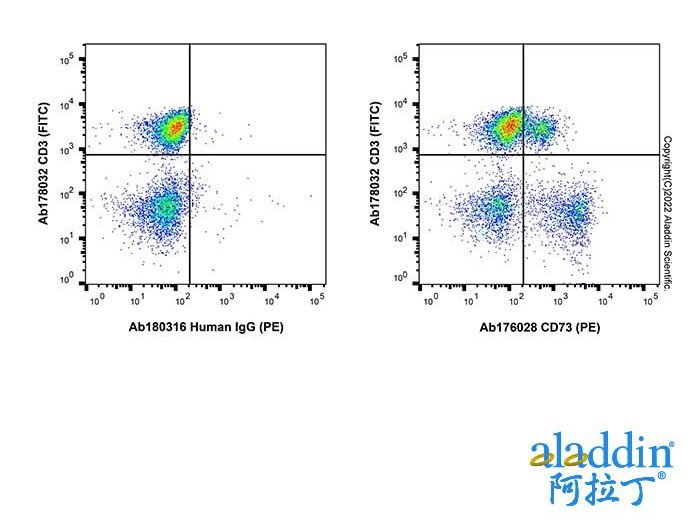
Human IgG (PE) (Ab180316) - Flow Cytometry
Human peripheral blood lymphocytes are stained with Recombinant CD3 Antibody (FITC) (Ab178032) and Recombinant CD73 Antibody (PE) (Ab176028) (Right). Lymphocytes are stained with Recombinant CD3 Antibody (FITC) (Ab178032) and Human IgG (PE) (Ab180316) (Left).
3. Application of isotype control antibodies
Although isotype controls are primarily used in flow cytometry, they can be used as standard blocking agents and protein coating agents for other applications, including immunohistochemistry (IHC), western blotting, and ELISA. Low-endotoxin isotype controls can also be used in in vivo animal experiments for drug efficacy assessment.
1. Flow cytometry:
When used for cell surface marker analysis, it is necessary to combine with FMO (fluorescence minus one) control to distinguish autofluorescence from nonspecific binding.
Example: Mouse IgG2a isotype control showed no positive signal when used to stain human PBMC, while CD4-specific antibody showed a clear fluorescence peak.
2. Immunohistochemistry (IHC) and Western Blot:
Be careful about tissue autofluorescence or secondary antibody cross-reaction; isotype controls can verify the specificity of the primary antibody.
3. In vivo efficacy evaluation:
Low endotoxin isotype controls can reduce nonspecific inflammatory responses in animal models.
The isotype control antibody is simply substituted for the primary antibody in the control sample during the experimental protocol, while the rest of the protocol is exactly the same (eliminating any other experimental variables). Therefore, the isotype control should be processed under the same conditions as the experimental samples; this includes using the same concentration of the isotype control antibody as the primary antibody. If a secondary antibody is used, the isotype control should be stained with the same secondary antibody.
4. Aladdin Isotype Control Antibody
(1) More than 100 isotype controls.
(2) Contains conjugated antibodies and unconjugated antibodies. Conjugated labels include AF405, AF488, AF555, AF647, AF700, APC, Biotin, FITC, PE, PE-Cy5, PE-Cy7 and other markers.
(3) Covering multiple subtypes (subchains): IgG, IgG1, IgG2, IgG3, IgG4, IgG2a, IgG2b, IgG2c, IgG1-Fc, IgG1-VHH, IgY.
(4) Available species: Mouse, Rat, Human, Rabbit, Goat, Armenian Hamster, Syrian hamster, Horse, Cat, Chicken, Cow, Dog, Guinea pig, Pig, Sheep.
Isotype control antibodies are the cornerstone of experimental design, and their correct selection and use directly affect data reliability. With the advancement of antibody engineering technology, customized, highly specific control reagents will further promote the development of precision medicine research.
For more product details, please visit Aladdin Scientific website.
Categories: 实验方案(Protocols)